Oil sludge is one of the most challenging hazardous wastes generated by the petroleum industry. Millions of tons are produced annually from drilling, refining, and storage tank cleaning. This sticky emulsion of oil, water, and solid particles contaminates soil and groundwater if left untreated. However, modern thermal desorption technology offers a complete solution. By following a systematic five-step process—dewatering, crushing, pyrolysis, oil gas recovery, and residue utilization—operators can transform hazardous sludge into valuable fuel oil, clean sand, and recovered water. This guide provides a technical deep dive into each stage, covering equipment requirements, process parameters, and economic outcomes.
Step 1: Dewatering – Removing Free Water for Efficient Processing
Raw oil sludge typically contains 40% to 85% water, depending on its source. Tank bottom sludge may hold 40–70% water, while air flotation sludge can exceed 75% water. This high moisture content is the enemy of pyrolysis. Water absorbs heat, slows the reaction, and increases energy consumption. Therefore, dewatering is the critical first step. Mechanical methods work best: centrifuges spin the sludge to separate free water; belt filter presses squeeze out moisture; thermal dryers evaporate remaining water using waste heat. The goal is to reduce moisture content to below 20%—ideally 10–15%. Dewatered sludge becomes a paste-like solid that flows easily into a pyrolyzer. Importantly, the recovered water can be treated and reused for cooling or washing, reducing freshwater demand. For operators using a oil sludge pyrolysis plant, investing in a robust dewatering stage pays back quickly through lower fuel bills and faster cycle times.
Step 2: Crushing – Particle Size Reduction for Uniform Heating
After dewatering, oil sludge often contains lumps, rocks, and debris. These large particles create “cold spots” inside the reactor, leading to incomplete carbonization and uneven product quality. Crushing solves this problem. A double-shaft shredder or hammer mill reduces the sludge to a uniform particle size of 10–20 mm. This small size increases the surface area exposed to heat, accelerating the pyrolysis reaction. For oil sludge with high solid content (e.g., oil-based cuttings containing 60–80% solids), crushing also liberates trapped oil from rock particles. In continuous systems, a crusher is integrated directly after the dewatering unit, feeding a buffer hopper that supplies the pyrolysis reactor at a steady rate. Operators should monitor particle size regularly; oversized chunks cause bridging in screw feeders and require manual clearing. A well-crushed feed enables the reactor to run at full capacity without blockages, directly improving throughput and oil yield.
Step 3: Pyrolysis – Thermal Cracking in an Oxygen-Free Reactor
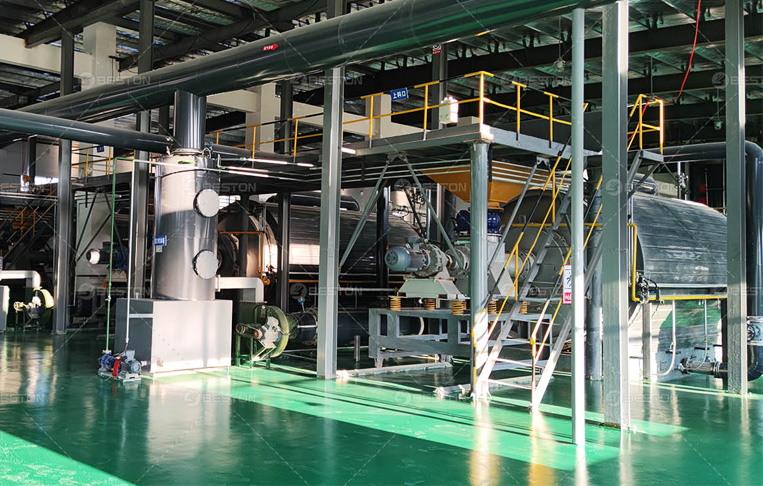
Pyrolysis is the heart of the entire process. The dewatered, crushed sludge enters a sealed reactor that is heated to 350–550°C in the absence of oxygen. Under these conditions, the long-chain hydrocarbon molecules in the oil sludge crack into shorter molecules, vaporizing into oil gas. The solids—sand, clay, and metals—remain as a char-like residue. For hazardous oil sludge, a dedicated thermal desorption unit is often the best choice. Unlike simple pyrolysis reactors, a thermal desorption unit (TDU) is specifically designed to handle sticky, abrasive, and corrosive sludges. Key features include: internal mechanical chain de-coking to prevent material buildup on reactor walls, water-cooled screw discharge to safely remove hot solids, and nitrogen purging to maintain an inert atmosphere. The reaction proceeds in stages. From 100–250°C, residual water and light volatiles evaporate. The main cracking occurs from 280–450°C, producing the bulk of the oil gas. Above 500°C, secondary cracking generates more non-condensable syngas. For maximum liquid oil yield, operators should hold the temperature at 400–450°C with a residence time of 20–40 minutes. Modern continuous systems automatically control these parameters.
Step 4: Oil Gas Recovery – Condensation and Syngas Recycling
The hot oil gas leaving the reactor is a mixture of condensable hydrocarbons (which become liquid oil) and non-condensable gases (methane, ethane, hydrogen). Recovery involves two sub-steps. First, the gas passes through a multi-stage condensation system. Shell-and-tube heat exchangers cool the gas to 30–50°C, turning 70–85% of the hydrocarbon vapor into liquid pyrolysis oil. Heavier fractions condense first (around 170°C), while lighter naphtha fractions condense below 40°C. The recovered oil is stored in tanks for sale as industrial fuel or for further refining into diesel. Second, the non-condensable syngas is scrubbed to remove hydrogen sulfide and other acids, then recycled back to the reactor’s burner. This syngas provides 50–80% of the heat required for pyrolysis, drastically reducing external fuel costs. In a well-designed continuous pyrolysis plant, the syngas recycling loop, combined with hot flue gas recirculation, can achieve energy savings of 55% compared to batch systems. Operators must monitor the condenser efficiency daily; any drop in oil recovery usually indicates fouled heat exchanger tubes or a cooling water issue.
Step 5: Residue Utilization – Turning Solid Waste into Valuable Products
After pyrolysis, the solid residue exits the reactor at 350–450°C. It consists of sand, clay, metals, and a small amount of fixed carbon (typically 5–15% by weight). This residue is not hazardous—the thermal desorption process has destroyed the organic contaminants. However, it is hot and must be cooled. A water-cooled screw conveyor brings the temperature down to below 45°C. The cooled residue then passes through a magnetic separator to recover any metal scrap (which can be sold to recyclers). The remaining sand and mineral fraction has several beneficial uses. It can be used as a construction fill material, as an additive in cement or asphalt production, or as a component in brick manufacturing. In some jurisdictions, the residue qualifies as non-hazardous and can be used for land reclamation. For oil sludge containing high levels of heavy metals (e.g., from refinery waste), the residue may require stabilization with cement before landfilling. However, the goal is always to maximize reuse. Some advanced Beston Group plants incorporate a residue washing stage to further reduce the oil content to below 0.3%, allowing the sand to be used as a clean backfill material.
Economic and Environmental Benefits of Complete Oil Sludge Pyrolysis
Implementing the full five-step process delivers multiple revenue streams and environmental credits.
- The primary revenue is pyrolysis oil (typically 10–25% yield from oil sludge, depending on original oil content). This oil sells as industrial fuel for $300–600 per ton.
- The secondary revenue is disposal fees. Many generators of oil sludge (refineries, drilling companies) will pay $100–300 per ton for compliant treatment.
- The third revenue source is recovered solids (sand and metals) which can be sold or used on-site. Additionally, the process reduces the volume of hazardous waste going to landfill by 70–90%.
Environmentally, thermal desorption eliminates the risk of oil sludge leaching into groundwater and avoids the air emissions associated with open burning or land spreading. With tightening regulations such as the EU Industrial Emissions Directive, pyrolysis-based treatment is becoming the mandated best available technology (BAT) for oil sludge. Operators who invest now position themselves to capture both regulatory compliance markets and growing demand for recycled fuels.


